A clever global campaign to create and promote questionable science undermining support for green energy has been funded in large part by American oil giant Koch Industries.
Greenpeace has done the research tracing nearly $50 million of Koch money over nine years going to climate denial organisations, some of which was used to create non-reviewed junk science including the one that denies global warming is harming polar bears. You've probably heard of that one.
Other 'research' projects purported to show that converting to clean energy reduced employment, but were equally flawed. However the most common use of the money is to disseminate these factoids throughout the media and to lobby governments and politicians to keep burning fossil fuels, protecting Koch’s profits.
Why they don't just use the money to diversify into green energy and make money that way, I don't know. Perhaps it's simply the conservative mindset.
Science was reason's triumph… the defeat of the Beast. But what happened when the Beast learned science? – Arthur Miller
Wednesday, March 31, 2010


Tuesday, March 30, 2010
A favourite Labor furphy attacked
The Sydney Morning Herald has been kind enough to publish another of my letters, this one responding to a slightly strange attack on The Greens by Finance Minister Lindsay Tanner that ran nationally in the Fairfax press.
I didn't have the space to query his outrage that, in his electorate, The Greens outpolled the Liberals and a swag of Lib preferences went their way. Tanner frames this as some sort of unholy alliance rather than simply the swings and roundabouts of the preferential system.
If he doesn't like it, perhaps he would prefer a proportional representation system which grants parties the same proportion of parliamentary seats as the percentage of their vote. Under this system The Greens would have several seats in the House of Representatives whereas now they have none. Be careful what you wish for, Mr Tanner.
Another way to see the preferences swing is that there is so little difference between Liberal and Labor that people are voting accordingly.
Text of my letter:
No compromise on useless policy
Lindsay Tanner does himself no favours by repeating Labor's favourite furphy about the Greens opposing its climate change legislation ("Greens do nothing to bring about change", March 25). His criticism implies the legislation would have achieved something. But its targets were a joke and there were so many compensations to the big polluters that anyone serious about addressing climate change would have to reject it.
It's true that politics is about compromise, but Labor's scheme would have locked Australia into climate vandalism for decades. Better to have no legislation and the hope of some real improvement. Calling this "political posturing" reveals more about Labor's bankrupt approach to politics than any supposed Greens cynicism.
Michael Gormly Woolloomooloo
War on Drugs failing -- US Government
The National Drug Threat Assessment from the US Dept of Justice says the supply of all drugs except cocaine was increasing, and were being distributed through ever-widening dealer networks. This is despite constant budget increases for the War on Drugs since Richard Nixon declared the war around 40 years ago. Drug War warriors will use the assessment to demand yet more money to escalate the war. Reformers are using it as evidence that the WoD is lost and unwinnable.
Some points from the Assessment:
Nevertheless Barack Obama has ruled out any Federal moves towards legalisation, while on the other hand continuing to tolerate the ever-growing medical marihuana movement in the 14 states which have legalised it.
-----------------------------
Conservative Fox News commentator John Stossel has a different take on it, documenting some of the outright lies the Drug Warriors tell to reinforce their industry.
Some points from the Assessment:
•Increased heroin availability evidenced by higher purity, lower prices, and elevated numbers of heroin-related overdoses and overdose deaths is partly attributable to increased production in Mexico from 17 pure metric tons in 2007 to 38 pure metric tons in 2008, according to U.S. Government estimates.
•Despite recent government of Mexico (GOM) efforts to prohibit the importation of methamphetamine precursor chemicals, methamphetamine availability increased as the result of higher production in Mexico using alternative, less-efficient precursors. Sustained domestic production also contributed to the increased availability levels.
•Marijuana production increased in Mexico, resulting in increased flow of the drug across the Southwest Border, including through the Tohono O'odham Reservation in Arizona.
•Asian drug trafficking organizations (DTOs) are responsible for the resurgence in MDMA availability in the United States, particularly since 2005. These groups produce the drug in Canada and smuggle it across the Northern Border into the United States.
•Cocaine shortages have persisted in many U.S. drug markets since early 2007, primarily because of decreased cocaine production in Colombia but also because of increased worldwide demand for cocaine, especially in Europe; high cocaine seizure levels that continued through 2009; and enhanced GOM counterdrug efforts. These factors most likely resulted in decreased amounts of cocaine being transported from Colombia to the U.S.-Mexico border for subsequent smuggling into the United States.
Nevertheless Barack Obama has ruled out any Federal moves towards legalisation, while on the other hand continuing to tolerate the ever-growing medical marihuana movement in the 14 states which have legalised it.
-----------------------------
Conservative Fox News commentator John Stossel has a different take on it, documenting some of the outright lies the Drug Warriors tell to reinforce their industry.
Wednesday, March 17, 2010
War against Kings Cross rages on

But there is plenty happening, with Council considering responses to its Late-night trading research.
Despite many comments including mine pointing out gaping holes in the research which fails to actually support Council's anti-pub agenda, Council is ignoring them and forging on regardless.
Clover Moore still wants to regulate into being a 'civilised' and 'sophisticated' late night culture, with bookshops and art galleries open till 3am, which is fine by me. But you can't regulate civilisation and sophistication (putting aside that the latter word comes from 'sophistry' which I am sure Ms Moore did not intend).
No, regulation just bans things and I am more and more convinced that the very late-night monoculture Councillors complain about is the result of their own regulation plus the uncivilised nature of a minority of suburban yobs and thugs which, short of building a wall around the city, we will always have to put up with.
With almost all street life banned, and sniffer dogs everywhere, over-regulation has created a city where there is nothing else to do besides drink on a night out. The forced closure of the wonderful Quirkz venue in Marrickville is a case in point.
But Council wants even more power legislated by the state so they can really get stuck into the late-night economy.
Cr Chris Harris correctly thinks that Responsible Service of Alcohol rules are a joke, but wants a whole bunch of enforcers trained to patrol pubs and decide who can have a drink and who can't.
Give me a break, Chris. Half the current tension and violence is caused by endless security trolls ordering adults about. I for one go to a pub to relax and do not want to be supervised by some straight authority figure making arbitrary decisions about me. Their judgements will be no more objective than bar staff. The only way to do that is to breathalyse everyone who wants a drink. Is that the brave new world you want?
No, what should be policed is bad behaviour towards others, nothing more or less. I and my friends can consume any amount in a night and not become aggressive or troublesome. Get your moral panic off my back and off my town, Councillors.
Links to recent City News stories detailing all the new rules people want, and my comment on the alcohol research are here, here, and here for a very salient Graffito of the week. More being published tomorrow including an entertaining piece My Quiet Street and a comment piece in The Hub.
Oh, and Council continues to block Cowper Wharf Road in Woolloomooloo to protect the genteel citizens of Macleay St from the horrors of car hoons, despite one of the residents who spoke on the late-night-trading research saying that the blockades "hadn't really worked". But Councillors are simply ignoring that, along with anything else that doesn't fit their temperance mindset. If you read My Quiet Street, linked above, you'll see why we have little sympathy for the residents of Macleay St!
Picture: A KX nightclub ad from 1964. A swinging place to rendezvous indeed.
Monday, March 08, 2010
A good argument to legalise ecstasy

If the only argument against ecstasy they can dredge up is that illegal manufacture is unregulated and possibly unsafe, the logical conclusion is to legalise, tax and regulate it. That would eliminate yukky scenes like this.
Face facts indeed.
[The ad appeared in a Mardi Gras publication distributed around the Oxford Street gay scene]
Tuesday, March 02, 2010
Prohibition increases murders while anti-drug ads don't work
Just as the Federal Government is about to launch another shock-horror anti-drug advertising campaign, another study has concluded that such campaigns do no good at all because they trigger a self-defensive coping mechanism in the intended targets. This campaign will target cannabis and ecstasy, the two least harmful illicit drugs, and ice.
Health Minister Nicola Roxon justifies the campaign with panic-inducing cherrypicked statistics about youth drug-taking that ignore the fact that use of these drugs is in significant decline. She highlights the use of drugs by very young teenagers but never mentions that, as this is happening under prohibition, maybe prohibition fails to protect youngsters from drug use because unregulated dealers in the schoolyard don't have to ask for ID.
I found some interesting stats about the effectiveness of prohibition in the form of two graphs covering the last century that show the more governments spend on prohibition, the more murders are committed. If that seems counter-intuitive, just think of Al Capone in the 1920s and bikie gang warfare in more recent times, both made rich by dealing in the banned substance. The graphs are part of an interesting empirical analysis of the self-defeating effects of prohibition from Boston University, well worth a read.

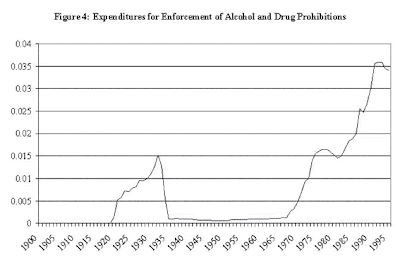
This graphically illustrates how prohibition is more harmful than the drugs it fails to control.
Health Minister Nicola Roxon justifies the campaign with panic-inducing cherrypicked statistics about youth drug-taking that ignore the fact that use of these drugs is in significant decline. She highlights the use of drugs by very young teenagers but never mentions that, as this is happening under prohibition, maybe prohibition fails to protect youngsters from drug use because unregulated dealers in the schoolyard don't have to ask for ID.
I found some interesting stats about the effectiveness of prohibition in the form of two graphs covering the last century that show the more governments spend on prohibition, the more murders are committed. If that seems counter-intuitive, just think of Al Capone in the 1920s and bikie gang warfare in more recent times, both made rich by dealing in the banned substance. The graphs are part of an interesting empirical analysis of the self-defeating effects of prohibition from Boston University, well worth a read.


This graphically illustrates how prohibition is more harmful than the drugs it fails to control.
Monday, March 01, 2010
How US prohibitionists poisoned Americans for their own good

Today we see the 6,500 killed in Mexico's War on Drugs in one year. But during alcohol prohibition in the 1920s the US government ordered that industrial alcohol be laced with poison in an attempt to stop people drinking illegal moonshine re-distilled from the industrial product -- reports the author of a book on poison.
It didn't work.
"In 1926, in New York City, 1,200 were sickened by poisonous alcohol; 400 died. The following year, deaths climbed to 700. These numbers were repeated in cities around the country as public-health officials nationwide joined in the angry clamor," reports Deborah Blum.
Up to 10,000 died nationally.
Ms Blum likens this to the ideas of today's hard-core prohibitionists who want to spray crops of cannabis, coca or opium -- in other people's countries -- with herbicide. She mentions rumours that the CIA still laces illicit drugs with poison.
And we don't have to look abroad for examples of this "kill them for their own good" thought pattern. A couple of years ago Don Wedderburn, head of BOCSAR, the Bureau of Crime Statistics and Research, published an opinion piece supporting drug prohibition titled something like "We need to inflict harm to prevent harm". No doubt the Don would not approve of poisoning people for their own good, but it's only a matter of degree -- the principle is the same.
Friday, February 19, 2010
Death penalty more dangerous than drugs

------------------------
From March 8 to 12, 2010 during the yearly meeting of the United Nations Commission on Narcotic Drugs in Vienna, governments from all over the world will once again declare their support to the global fight against drugs, i.e. the substances that were prohibited worldwide by a UN Convention in 1961.
In Malaysia, as in 21 other countries in the world, people who use or possess relatively small quantities of drugs, including cannabis, are sentenced to death. These sentences are mandatory: judges have no possibility to invoke any extenuating circumstance. Furthermore, the usual burden of proof is reversed so that an individual is presumed to be guilty unless he or she can prove otherwise.
International Conventions on Human Rights, various UN Human Rights Bodies and the UN Secretary General have expressed that the “death penalty should only be considered in cases where the crime is intentional and results in lethal or extremely grave consequences, not in cases of economic, non-violent or victimless offences. In those cases a death sentence may be considered as an arbitrary execution.”
The use, sale or trafficking of drugs is not intended to have a lethal outcome. People use drugs to feel good or to feel better, and as long as there is a demand there will always be a supply. Also in Malaysia, drug use has continued to rise in spite of the death penalty. The people who are occasionally caught by authorities do not have major responsibilities in this business. Killing them will not scare the drug gangs away. On the contrary: thanks to these punishments, the leaders in the drug business can continue to justify extraordinary high prices for their goods
Legitimized by the United Nations, drug prohibition continues to drive repressive policies and legislation including death sentence. These policies are typically rooted in moral in stead of rational arguments, and impede the development of progressive and effective responses to any problems that the use of drugs may cause.
-- From the European Coalition for Just and Effective Drug Policies (ENCOD)
Ref: http://www.encod.org/info/PICKET-LINE-IN-FRONT-OF-THE.html
Wednesday, February 17, 2010
NZ politicians defy drug law review advice
Ruling conservatives in New Zealand have categorically refused to follow the advice of their own drug law review even though its terms of reference restricted it to a prohibition model. The Law Commission Review concluded that the Misuse of Drugs Act 1975...
The NZ government has categorically rejected the conclusions, saying that such efficiency and harm reduction would "send the wrong message". They don't seem to be able to come up with more substantial arguments, and they ignore the rather obvious fact that the government, if it adopted the Review's advice, could use some of the money it saved to send any message it liked through education and advertising.
It seems they prefer 'sending a message' of ideological inflexibility, higher levels of drug use and harm, and wasting police time and money. So much for economic rationalism.
A more thorough report on the issue from the NZ Drug Foundation is published in the Pundit.
...no longer provides a coherent and effective legislative framework for responding to the misuse of psychoactive drugs... The Act is now outdated and does not reflect current knowledge and understanding about drug use and related health, social and economic harms.The Commission recommended a caution and diversion approach for people charged with personal use of small quantities of drugs, citing overwhelming Australian evidence that this approach saved police time, reduced the load on courts and prisons and reduced drug use and re-offence.
The NZ government has categorically rejected the conclusions, saying that such efficiency and harm reduction would "send the wrong message". They don't seem to be able to come up with more substantial arguments, and they ignore the rather obvious fact that the government, if it adopted the Review's advice, could use some of the money it saved to send any message it liked through education and advertising.
It seems they prefer 'sending a message' of ideological inflexibility, higher levels of drug use and harm, and wasting police time and money. So much for economic rationalism.
A more thorough report on the issue from the NZ Drug Foundation is published in the Pundit.
Friday, February 12, 2010
Conroy wants to block safe drug use videos
Google should block Youtube videos demonstrating safer ways to use drugs, says Communications Minister Stephen Conroy as reported in The Sydney Morning Herald.
Google is resisting, saying it has a "bias" towards free speech.
Conroy is setting up a filter system to block RC (refused classification) material from Australian web users, hanging his hat on that old standby, child pornography which is to my knowledge not available on the web anyway except on peer-to-peer networks.
Conroy even uses China as an example of how it can be done, raising the spectre of oppressive government control of information and free speech. We used to say "It's a free country, mate," but those days are gone as a succession of freedoms and rights are removed by power-mad governments consumed by moral panic and imposing a nanny state. On my recent trip to China I found all Blogger blogs (like this one) were blocked, along with facebook and, strangely, the newspaper I write for, The City News. Welcome to the Brave New World.
Denying people information about the safe use of drugs can only result in the less safe use of drugs, so Conroy's latest mania can only cause harm. So much for the government's commitment to "harm minimisation".
Other reports claim that his obsession with protecting the rest of us from things he doesn't like will extend to banning pornography featuring women with small breasts, in case someone fantasises about having sex with children. Women with small breasts are angry, saying that yet more big-breasted stereotypes would be of doubtful benefit to society.
Someone said to Tony Abbott the last time he was on his anti-abortion kick, "Get your rosaries off my ovaries". Something similar applies to our Minister for Censorship.
Thursday, February 11, 2010
Pastor calls for end to War-on-Drugs casualties

Why on earth don't we get the UN to buy the whole heroin crop from farmers in Afghanistan to use it for legitimate medical needs around the world. Bingo! Instant defunding of all the warring groups who fund their mayhem by the sale of heroin. I've spoken to people in high places about Afghanistan and the truth is that no one sees any end in sight. I don't often get on a soap box but I just loathe the idea of young Australians dying in some cause that has no end. Perhaps if we took the market away from the Taliban and the other warring factions, they'd be struggling to fund a single bullet. While I'm on the box, I wonder when we'll wake up that our war on drugs is a war on people. Actually, it's a war on poor people. Every time I think of the Bali nine, it sticks in my neck that our AFP handed Australian young people over to a potential death sentence. Do you think the AFP would have taken this action if one of the nine had been the son of the Prime Minister? We could save a fortune as well as some lives if we took the drug market out of the hands of criminals. I'm expressing the view of a small minority but one that I think will start to make sense when governments become motivated to pay off their debt. One day, we'll see that today's orthodoxy is expensive and unproductive. I don't get on my box often but ever since 1964 The Wayside Chapel never pretended to be a not for prophet organisation.
How Science is spun to support ruling agendas
Another look at the UK study in the post below illustrates how research into drugs is reported in a way that amplifies the downside, increases the moral panic about drugs, provides superficial ammunition for prohibitionists and encourages more funding from prohibitionist governments.
I used the study to illustrate the extremely low relative risk of taking ecstasy, comparing it to the thousands of casualties from the War on Drugs.
But Science Daily, reporting on the same study, feeds the moral panic, headlining with: "Fatality Rates Among Young Drug Users A Cause For Concern".
It quotes lead author Professor Fabrizio Schifano who said: "These data seem to support the hypothesis that young individuals seem to suffer extreme consequences after excessive intake of ecstasy. This is an issue of public health concern which deserves further studies."
This statement has been likened to Steven Fry's observation that "Too much is bad for you because that's what too much means". It's a classic example of begging the question.
Note the thinly disguised call for further funding at the end of Prof Schifano's quote, perhaps showing how research findings are reported in a way that foments moral panic in the interests of more funding -- no reflection on the good professor's scientific rigour. The politics of the system are to blame, not, generally, its practitioners who would be out of a job if they openly challenged the funding source. It's a sad reflection on the independence of Science.
New figures prove prohibition far more harmful than drugs
A new UK study shows just how relatively few deaths are caused by ecstasy. Published in the journal Neuropsychobiology, it looked at reported ecstasy-related deaths from 1997 to 2007, comparing them to amphetamine-related deaths. It reports 605 deaths using the widest definition of "ecstasy-related".
By comparison, 6,500 people were killed last year alone in Mexico's War on Drugs according to The New Scotsman. This is starkly illustrates that prohibition causes far more harm than the drugs it fails to control.
While any death is obviously a matter for concern, risks should be put into perspective. The UK study provides data that helps this. Looking at younger users who reportedly took only ecstasy (mono-intoxication), the Abstract says:
From memory, a lot of the 'reporting inconsistency' mentioned in the abstract introduced significant inaccuracy. Because these substances are illegal and unregulated, there is no guarantee that MDMA was even the active substance used. I wonder how many cases of the more dangerous GHB or PMA poisoning slipped into that percentage? Nor, of course, would the actual dose per tablet have been known, and nor were there instructions or warnings available on the non-existent packet they came in -- basic information that comes with a packet of Aspirin because it is legal and regulated, and which presumably prevents much 'excess intake'. Also, because MDMA is illegal, the buyers did not have to provide ID on purchase. Such a regime would to some extent reduce the drug's availability to the under-18s studied.
I wonder by how much that 0.0000167% might have been reduced had these safety factors, routinely applied to pharmaceuticals, existed under a legal, regulated and taxed regime.
And I wonder what the cost of prohibition enforcement is for each of those 1.67 deaths per 100,000 users, and whether there are more cost-effective ways of addressing drug abuse.
Meanwhile in Mexico:
Even talking in absolute figures, and including multi-intoxication deaths, that's a total of 605 ecstasy-related deaths over ten years in the UK compared to 6,500 deaths in one year in Mexico.
Yet prohibitionists from Drug Free Australia have cited the UK study in their prohibitionist campaign. I have invited them to comment on the relative risks of ecstasy vs prohibition.
PS Another analysis of The Courier Mail recently hyping an ecstasy scare is found at The Australian Heroin Diaries. Do journalists learn this formula at some obscure trash tabloid school, or are they just born that way?
PPS As of 19 February, Drug Free Australia had not taken up my invitation to challenge the above analysis.
By comparison, 6,500 people were killed last year alone in Mexico's War on Drugs according to The New Scotsman. This is starkly illustrates that prohibition causes far more harm than the drugs it fails to control.
While any death is obviously a matter for concern, risks should be put into perspective. The UK study provides data that helps this. Looking at younger users who reportedly took only ecstasy (mono-intoxication), the Abstract says:
...However, mono-intoxication ecstasy fatalities per 100,000 16- to 24-year-old users were significantly more represented than AMP/METH fatalities (1.67 ± 0.52 vs. 0.8 ± 0.65; p = 0.0007). Conclusion: With respect to AMP/METH, ecstasy was here more typically identified in victims who were young, healthy, and less likely to be known as drug users. AMP/METH high mortality rates may be explained by users’ high levels of physical co-morbidity; excess ecstasy-related fatality rates in young users may be a reason for concern. Although the coroners’ response rate was of 90–95%, study limitations include both reporting inconsistency over time and lack of routine information on drug intake levels prior to death.So we are talking about 1.67 'mono-intoxication ecstasy related' deaths per 100,000 users. That's a percentage of 0.0000167 (ignoring the error factor, and according to my calculator). That makes ecstasy one of the safest substances around -- and the percentage would be even lower if they compared casualties to the number of doses rather than users, given that most users take more than one dose in the drug-using period of their life.
From memory, a lot of the 'reporting inconsistency' mentioned in the abstract introduced significant inaccuracy. Because these substances are illegal and unregulated, there is no guarantee that MDMA was even the active substance used. I wonder how many cases of the more dangerous GHB or PMA poisoning slipped into that percentage? Nor, of course, would the actual dose per tablet have been known, and nor were there instructions or warnings available on the non-existent packet they came in -- basic information that comes with a packet of Aspirin because it is legal and regulated, and which presumably prevents much 'excess intake'. Also, because MDMA is illegal, the buyers did not have to provide ID on purchase. Such a regime would to some extent reduce the drug's availability to the under-18s studied.
I wonder by how much that 0.0000167% might have been reduced had these safety factors, routinely applied to pharmaceuticals, existed under a legal, regulated and taxed regime.
And I wonder what the cost of prohibition enforcement is for each of those 1.67 deaths per 100,000 users, and whether there are more cost-effective ways of addressing drug abuse.
Meanwhile in Mexico:
...40 people died in firefights between police and army forces and the drug cartels. More than 6,500 fatalities will have occurred this year alone, topping last year's total, which was double that in 2007...That was written by Jorge G Castañeda, former foreign minister of Mexico (2000-3), a Global Distinguished Professor of Politics and Latin American Studies at New York University, in The New Scotsman.
Of the 220,000 people arrested on drug charges since Mr Calderón took office, three-quarters have been released. Only 5 per cent of the remaining 60,000 or so have been tried and sentenced.
Even talking in absolute figures, and including multi-intoxication deaths, that's a total of 605 ecstasy-related deaths over ten years in the UK compared to 6,500 deaths in one year in Mexico.
Yet prohibitionists from Drug Free Australia have cited the UK study in their prohibitionist campaign. I have invited them to comment on the relative risks of ecstasy vs prohibition.
PS Another analysis of The Courier Mail recently hyping an ecstasy scare is found at The Australian Heroin Diaries. Do journalists learn this formula at some obscure trash tabloid school, or are they just born that way?
PPS As of 19 February, Drug Free Australia had not taken up my invitation to challenge the above analysis.
Monday, February 08, 2010
Drug War dumbs down police, media
Reporting of the War against Drugs in NSW over the weekend again sunk to a nonsensical level of fallacy and propaganda, covering our police and major media in shame.
Both The Sun-Herald and ABC News parroted inaccurate media output from Police Minister Michael Daley but obtained no opposing comment, breaking rule 101 of journalism.
Here's a summary of what Daley said, with rebuttals in counterpoint.
From The Sun-Herald:
From ABC News:
But his fallacies continue:
But Mr Daley is not just spouting discredited information to a slavish, unprofessional media. he is attempting to shore up his own police force. This from the USA's Alternet blog, asking why police always say the same sort of stuff:
"Plain and simple. They are motivated by self-interest. Their very jobs depend on a steady stream of arrests and prosecutions. And marijuana users are their cash cow, with arrests totaling a staggering 847,863 in 2008. As long as the marijuana arrests keep coming, so do their paychecks. Keep this in mind the next time you hear a law enforcement official explaining why we need to “protect our streets” from this “dangerous drug.”
Ref: http://www.smh.com.au/national/ecstasy-use-up-as-police-seize-drugs-worth-260m-20100206-njv3.html
Ref: http://www.abc.net.au/news/stories/2010/02/07/2812410.htm
Both The Sun-Herald and ABC News parroted inaccurate media output from Police Minister Michael Daley but obtained no opposing comment, breaking rule 101 of journalism.
Here's a summary of what Daley said, with rebuttals in counterpoint.
From The Sun-Herald:
NSW Minister for Police Michael Daley said the heroin seized last year was equivalent to 24 million hits and would hopefully drive up the price of drugs and deter use.-- but driving up the price increases the profit motive in the black market, and attracts greater interest from local and overseas exporters. And 24 million hits sounds like a lot but is only a tiny fraction of the annual market, same as every year. The article lists increases in arrests for most drugs, especially ecstasy. This could reflect different police priorities or it could reflect greater supply and use, which would make a mockery of the War.
From ABC News:
Police praised for cannabis busts-- With the national Crime Commission estimating the imported drugs market alone at up to $12 billion annually, police interceptions are and always were just a scratch on the surface. But they never put their overblown estimates in that context.
The New South Wales Government has commended the state's police for seizing $50 million worth of cannabis in the past three months.
"We have intelligence from the public. We used helicopters heavily this week in the Tweed, went up in the air and looked down for the plantations on the ground [and] different colouration of vegetation," he said.-- So they rely on people dobbing in their neighbours and spending a fortune on polluting helicopter surveillance to stop a few people using a recreational drug that's far safer than alcohol.
Unfortunately some people think of cannabis as a soft drug. It isn't.-- but it is, Mr Daley
It does cause psychosis.-- maybe, but only in a tiny fraction of one percent of users, making it far safer than just about anything.
It's a gateway drug to heavier use-- No it's not, Mr Daley, although your War on Drugs makes sure that anyone who has access to it on the black market can likely get harder drugs from the same source. For a start, simple mathematics shows that only a tiny percentage of cannabis users ever inject harder drugs. However propagandists like Mr Daley will quote the opposite statistic, that nearly all hard drug users used cannabis first, ignoring that they probably used alcohol before that. Here's some recent research that Mr Daley should read before mouthing discredited truisms in future...
But his fallacies continue:
and it's a cash crop for bikie gangs and organised crime.-- only because your War on Drugs creates the opportunity for criminals to get into the business, Mr Daley. Talk about a self-fulfilling prophesy.
New South Wales police say they have seized more than 50,000 cannabis plants - with an estimated street value of $190 million - over the past year.See above re the total value of the drugs market. And the police always overstate the value of seized drugs.
But Mr Daley is not just spouting discredited information to a slavish, unprofessional media. he is attempting to shore up his own police force. This from the USA's Alternet blog, asking why police always say the same sort of stuff:
"Plain and simple. They are motivated by self-interest. Their very jobs depend on a steady stream of arrests and prosecutions. And marijuana users are their cash cow, with arrests totaling a staggering 847,863 in 2008. As long as the marijuana arrests keep coming, so do their paychecks. Keep this in mind the next time you hear a law enforcement official explaining why we need to “protect our streets” from this “dangerous drug.”
Ref: http://www.smh.com.au/national/ecstasy-use-up-as-police-seize-drugs-worth-260m-20100206-njv3.html
Ref: http://www.abc.net.au/news/stories/2010/02/07/2812410.htm
Thursday, February 04, 2010
Another climate sceptic mantra blown out of the water

A letter of mine published in the SMH today makes a small contribution to the climate change debate, noting that Tony Abbot would be "talking to industry" about penalties on industry for increasing carbon emissions. Comforting. It's like the judge asking a criminal what sentence they would like.
But the real heavy hitting came from a brilliant report by Matthew Wright that explodes the climate sceptics' eternal mantra that renewable energy cannot provide 'baseload power'.
Wright documents many cases where renewable energy IS already providing 'baseload power' in other countries on a scale similar to our own dirty coal-fired power stations. Much of it uses technology developed in Australia but activated overseas because our government will not support the industry here. As Wright points out, our coal-fired plants were developed with public subsidy, so the argument that renewables cost more is also compromised -- never mind that wind and sunlight are free and inexhaustible. These industries overseas employ similar numbers to our coal-based system, so the jobs argument raised by sceptics is also false.
As one commenter pointed out, noting that we have far more sunlight than any of these countries "We could be the Saudi Arabia of solar thermal instead of the saudi arabia of coal and uranium."
Wright's report lands some heavy blows on the nuclear lobby, too:
"Compared to the 10 years it takes to get a nuclear plant up and running, solar thermal plants with 24-hour baseload capacity have construction times as short as nine months."
The report also backs up my position in reports I published in The City News based on my street-level observations of renewable energy I saw installed in China over the summer break. Solar hot water systems were everywhere, a glaring difference between Chinese and Australian roofscapes. I saw many residential developments (like the one pictured, in Pingyao) which were low-rise, offering plenty of roof space to install the units. Our high-rise model, I suspect, houses no more people per hectare but locks out the solar hot water option. I priced a household solar unit in Dali (a quote that took about 15 seconds with no common language involved except sign language and a calculator!) at around $400. Wright puts the price at "Under $500." The technology was invented in Australia, so why are we charged several times this price? Are you there, Kevin Rudd?
No, he's not. All the above has been endlessly broadcast by The Greens, those "irresponsible radicals". It's time the media stopped focusing on the meaningless Liberal/Labor debate and got real by comparing those farcical deceptions to Greens' policies that are already reality in other more progressive countries.
Links to previous China Postcards in The City News: Drop the red Lanterns, It's the small things that add up.
Sunday, January 24, 2010
Atheists tackle the drug war
A lucid piece on the Atheist Age site gives a good rundown on the lies and hypocrisy pushed by drug warriors, speaking in terms of "evidence-free, new age magic".
The unnamed author finishes up with a link to this site and some kind words:
The unnamed author finishes up with a link to this site and some kind words:
Michael Gormly is the author of Kings Cross Times from Woolloomooloo, Sydney. If you’re awake and a citizen of this planet, you really need to read what he has to say. Little wonder the Alternative Media Group published his piece.Meanwhile dodgy heroin supplied by the black market in Scotland seems to have been laced with Anthrax, killing seven so far. That's seven more lives lost to the War on Drugs, a war which ensures drug supply is unregulated and carried out by organised crime. All you conservatives supporting the War should be suffering intense guilt, for these seven lives are only the latest your policies have taken.
Wednesday, December 23, 2009
Mexico's horrific war on drugs failing
Mexico's horrific war on drugs is failing hopelessly even as all the drug business indicators get healthier. The war was declared for political reasons by a politically desperate President Calderon (Yes, that old story).
Señor Castañeda says the war is...
...40 people died in firefights between police and army forces and the drug cartels. More than 6,500 fatalities will have occurred this year alone, topping last year's total, which was double that in 2007...So reports Jorge G Castañeda, former foreign minister of Mexico (2000-3), a Global Distinguished Professor of Politics and Latin American Studies at New York University, in The New Scotsman.
Of the 220,000 people arrested on drug charges since Mr Calderón took office, three-quarters have been released. Only 5 per cent of the remaining 60,000 or so have been tried and sentenced.
Señor Castañeda says the war is...
...unwinnable because it fails to comply with the tenets of the Powell Doctrine, elaborated 18 years ago by Colin Powell, then chairman of the US Joint Chiefs of Staff, in relation to the first Gulf War.
Mr Powell enumerated four conditions that must be satisfied to succeed in a military operation. One was deployment of overwhelming force, which the Mexican military lacks. Another was definable victory, which one never has in a war on drugs. The third condition was an exit strategy at the outset, which Mr Calderón lacks, because he can neither withdraw in defeat in his own country, nor withdraw and declare victory.
Monbiot shreds Plimer
The battle over climate change has descended to the level of religious bickering since the sceptics have massaged enough anti-science to counter the mainstream of science on climate change.
Both sides can muster arguments sophisticated enough to baffle the average Joe, so such people have to accept one side or the other as a matter of faith.
So it's good to see one of the current stars of the sceptic movement, Professor Ian Plimer, being shredded on Lateline by non-scientist George Monbiot.
As blogged here previously, Plimer's book spouts numerous denial-side factoids that have been soundly and publicly discredited -- but there are always a few ignoramuses left who will believe them, so he keeps getting paid to spout them. Monbiot and host Tony Jones asked Plimer the hard questions about these points and Plimer evaded, evaded and evaded, unable to defend his stance.
This helps me avoid any crises of faith as I find it hard to believe someone who repeats an argument after it has been soundly discredited. Plimer is the inspiration for such leading 'experts in the field' as Tony Abbott and Barnaby Joyce, our alternative government. The sad thing is, the ludicrous flat-earthery of these people helps make Kevin Rudd look good by doing next to nothing.
It's almost funny.
Monday, December 21, 2009
Sounds from the vault -- early Fairlight demo
Classic 1970s uber-cool dudes demonstrate the new-fangled Fairlight synthesiser in 1980 -- it's played by Michael Carlos who was a bit of a keyboard hero for me in the early '70s, playing with Jeannie Lewis on her album Free fall through featherless flight and earlier with Tully.
While the clip shows the Australian origin of all today's techno sound, best of all is the endless grinding sound of the huge floppy disc loading some sounds (probably about 128k). Comparing that with today's flashcards, I wonder what we will be using 29 years from now?
While the clip shows the Australian origin of all today's techno sound, best of all is the endless grinding sound of the huge floppy disc loading some sounds (probably about 128k). Comparing that with today's flashcards, I wonder what we will be using 29 years from now?
Thursday, December 17, 2009
Violence down as moral panic rises
It's official -- alcohol-related violence IS down 4.5% over the past two years, even as Council clamps down on Sydney's night economy, repeatedly justifyling the policy with claims that violence is rising and 'out-of-control'.
The new figures, as reported in today's Sydney Morning Herald, come from the NSW Bureau of Crimes Statistics and Research.
They make nonsense of the statistics produced by Council's recent late-night trading research, with Clover Moore and her cohort repeatedly quoting that 60% of respondents "consider that those areas are experiencing increasing rates of alcohol-related harm, and that appropriate ways to reduce... such harm include... enforcing a ceiling in the number of alcohol outlets..."
Violence has reduced even more than the average in Kings Cross since a marked increase in high-visibility policing. The Cross interestingly escaped last weekend's well publicised orgy of violence as colourfully described by the police media blitz. The police have, significantly, departed from their usual plodspeak in favour of emotive language highlighting words like 'disgusting'. This marks a shift from straight policing to social engineering, all part of the moral panic.
We observed Kings Cross on Friday night from our favourite kerbside drinking and people-watching spot, and I wrote a commentary on the peaceful night, and the police blitz, for The City News.
The Sydney Morning Herald today also runs a spirited defence of the Nanny State which states:
Today's declining violence figures -- occurring even as the population rises -- lend weight to the latter proposition.
PS (23 12 09) The the Alcohol and other Drugs Council of Australia (ADCA) has joined the police in using morally loaded language: "Australia's 'Drinking Culture' - a National Disgrace" begins a pre-Christmas media release berating drinkers. It claims "84 per cent of Australians consider intoxication to be unacceptable" before listing the usual 'alcohol-related' horrors that fail to scare the kiddies. Meanwhile packed pubs and clubs around here continue to produce a babble of chatter and laughter whenever I walk past. I guess that must be the sound of the remaining 16 per cent of Australians.
The new figures, as reported in today's Sydney Morning Herald, come from the NSW Bureau of Crimes Statistics and Research.
They make nonsense of the statistics produced by Council's recent late-night trading research, with Clover Moore and her cohort repeatedly quoting that 60% of respondents "consider that those areas are experiencing increasing rates of alcohol-related harm, and that appropriate ways to reduce... such harm include... enforcing a ceiling in the number of alcohol outlets..."
Violence has reduced even more than the average in Kings Cross since a marked increase in high-visibility policing. The Cross interestingly escaped last weekend's well publicised orgy of violence as colourfully described by the police media blitz. The police have, significantly, departed from their usual plodspeak in favour of emotive language highlighting words like 'disgusting'. This marks a shift from straight policing to social engineering, all part of the moral panic.
We observed Kings Cross on Friday night from our favourite kerbside drinking and people-watching spot, and I wrote a commentary on the peaceful night, and the police blitz, for The City News.
The Sydney Morning Herald today also runs a spirited defence of the Nanny State which states:
so too has the public mood been transformed on alcohol by the violence, distress and other harms its causes for others....or has the public mood in fact been changed by a tsunami of moral panic unleashed by the AOD sector which gets more funding the more panic they foment, and by politically bereft governments trying to score points by getting 'tough on' things, and by a small army of nannys and NIMBYs?
Today's declining violence figures -- occurring even as the population rises -- lend weight to the latter proposition.
PS (23 12 09) The the Alcohol and other Drugs Council of Australia (ADCA) has joined the police in using morally loaded language: "Australia's 'Drinking Culture' - a National Disgrace" begins a pre-Christmas media release berating drinkers. It claims "84 per cent of Australians consider intoxication to be unacceptable" before listing the usual 'alcohol-related' horrors that fail to scare the kiddies. Meanwhile packed pubs and clubs around here continue to produce a babble of chatter and laughter whenever I walk past. I guess that must be the sound of the remaining 16 per cent of Australians.
Wednesday, December 16, 2009
Canberra wants your input on drug strategy
The next five years of drugs strategy is being formulated by the Federal Government. While they are seeking input from experts and the community, the following introduction on the consultation website implies that there will be no fundamental change:
If they were serious about that they would recommend more medically supervised injecting centres. The Kings Cross Centre has been evaluated to death, and it works well. Nevertheless it remains the only such facility in Australia and the NSW government maintains it on a trial-only basis.
All written submissions can be forwarded to the National Drug Strategy Consultation inbox (NDSconsultation@health.gov.au) or sent to:
National Drug Strategy Consultation
MDP 27
GPO Box 9848
Canberra ACT 2601
The closing date for submissions is Wednesday 24 February 2010.
Australia's National Drug Strategy 2004–2009 is in its final year of implementation. The Strategy has been evaluated by independent experts under the auspices of the Ministerial Council on Drug Strategy (MCDS). The evaluation found that the Strategy and its three pillars of supply, demand and harm reduction are fundamentally sound and have been vital to the success of the Strategy in reducing the prevalence of, and harms from, drug use in Australia over a long period.My translation of that: 'A prohibition model will remain despite a lack of objective evidence that it works, but we are prepared to strengthen harm reduction strategies.'
Nonetheless, significant harms from drug use continue to occur in Australia and new trends are emerging. This Consultation Paper aims to identify emerging issues and seek input from expert stakeholders and the broader community on directions for the next phase of the Strategy 2010–2015.
If they were serious about that they would recommend more medically supervised injecting centres. The Kings Cross Centre has been evaluated to death, and it works well. Nevertheless it remains the only such facility in Australia and the NSW government maintains it on a trial-only basis.
All written submissions can be forwarded to the National Drug Strategy Consultation inbox (NDSconsultation@health.gov.au) or sent to:
National Drug Strategy Consultation
MDP 27
GPO Box 9848
Canberra ACT 2601
The closing date for submissions is Wednesday 24 February 2010.
Thursday, December 10, 2009
Czechs decriminalise 15g of cannabis
The sizeable minority who enjoy recreational drugs other than alcohol can now do so in the Czech Rebublic without being persecuted by police, reports The Wall Street Journal.
Czechs drink the most beer and smoke the most cannabis of any country on the continent. As the WSJ points out, hops and cannabis are related botanically, being "the two sole members of the Cannabaceae family of plants."
Czechs will be able to carry up to 15g of cannabis or grow 5 plants for personal use. New rules for artificial drugs are being drafted which would allow people to carry two grams of methamphetamines, cocaine or heroin, five ecstasy pills or 5g of hashish without committing a criminal offence, reports Czech media.
Let's wait and see if the world ends or if people just do what they are doing anyway, minus the risk of arrest and jail.
PS 21.December.09 The Czech government has now decriminalised the harder drugs as well. The limits are:
Marijuana 15 grams (or five plants)
Hashish 5 grams
Magic mushrooms 40 pieces
Peyote 5 plants LSD 5 tablets
Ecstasy 4 tablets
Amphetamine 2 grams
Methamphetamine 2 grams
Heroin 1.5 grams
Coca 5 plants Cocaine 1 gram
Now Australian Governments need to either condemn the Czechs as irresponsible idiots, (and the Portugese, Dutch etc) or re-examine the prohibition culture here because Australia's laws are the idiotic ones... both propositions can't be true.
Wednesday, December 09, 2009
Copenhagen brings climate debate to a thunderhead

They even claim that climate change science is a global conspiracy by (a) the British Monarchy or (b) the communists whereas I think they are the ones in the pay of the fossil fuel industries. Here's a site with a neat list of climate sceptic organisations and where they get their money from. Surprise surprise, it's the oil and coal industries! Who would have thought!
And this article in today's SMH rounds up some science showing alarming global warming and extreme weather patterns -- as I wrote to the Herald in August when we had bushfires simultaneously in both hemispheres. It rings true to this lay person.
Photo: A storm out to sea pictured from the roof of the Blanco Restaurant building in Roslyn St, Kings Cross on 19 November. No, I'm not saying this is a result of global warming, it just seemed a graphic illustration. A few minutes later the storm produced a classic anvil thunderhead, below, as the sunset peeked through to highlight buildings in the eastern suburbs:

PS: 702 Radio is reporting the last six months were Australia's hottest on record with an average temperature of 20.1 degrees since June, according to the National Climate Centre. I know weather is not climate but... what's the downside of building renewable power stations and a decent rail network, just in case?
Are pushy web ads self-defeating?
Reading my news on The Sydney Morning Herald website, I get mildly annoyed by those ads that jump out and obscure the content. They are already highly animated to draw your attention, but at least they usually have an X button to close them. But today's ad for GIO's car insurance breaks new ground. Not only does it jump out but its 'close' button jumps around and is invisible most of the time, so you are drawn into a computer-game style shooting match instead of reading the news.
I don't even own a car. GET OUT OF MY FACE!
Result: I hate GIO. And the SMH.
I know it's problematic making money from web ads but I think this tactic damages everyone. If it keeps up I will simply turn elsewhere for my news.
I don't even own a car. GET OUT OF MY FACE!
Result: I hate GIO. And the SMH.
I know it's problematic making money from web ads but I think this tactic damages everyone. If it keeps up I will simply turn elsewhere for my news.
Saturday, December 05, 2009
Seized drugs boomerang back to the street
Another police-linked corruption scandal has erupted in Victoria, this time over shenanigans in the Forensic unit, reported The Age yesterday. It seems its civilian staff have been 'recycling' confiscated drugs and selling weapons that should have been destroyed.
This is one of the nasty side-effects of prohibition, which artificially inflates the price of drugs to the point where the temptation becomes too much for some scions of the law when a lucrative offer is made by crooks flush with cash from drug profits.
The black market industry, being unregulated, also attracts guns and shooters as criminals defend turf and punish wrongdoers.
The Age reports that "seized drugs were recycled by the former drug squad and either sold or given to informers as a reward for information."
It can be inferred that not only were drugs being 'recycled' but evidence was also being destroyed: "The 15-month Ombudsman's investigation began after an internal police audit found drugs worth millions of dollars were missing from the centre. The review found drugs listed as destroyed had been kept and exhibits that should have been stored were destroyed."
Two men have so-far been charged. In this case honest cops have blown the whistle on the crooks, which is heartening. But without prohibition, these honest cops would be better employed fighting actual crimes that hurt victims instead of spending their time digging out the endless dirt on their own side of the fence.
Thursday, December 03, 2009
The retail mix of Kings Cross, then and now

One consequence of the upgrade was killing the fruit barrow by moving it away from the station (where all those exiting the station passed it) into the mouth of Springfield Plaza (where only half the people exiting the station pass it). But Council didn't halve the rent and several operators have gone under. Now it sits there doing nothing but carry advertising and block the footpath. Does anyone have any ideas for an alternative use? It would make a great community access noticeboard... but Council bends over backwards to prevent THAT.
2004
17 closed
7 sex shop
7 fast food
7 Accommodation
6 Pub / Bar
6 internet
5 strip joint
4 Money exchange
4 convenience
4 chinese massage
4 Café
3 souvenir
3 photolab
3 chemist
2 Tobacconist
2 newsagent
2 Hairdresser
2 Drug addict facility
2 Bottle Shop
1 Tattoo
1 Tab
1 Phone Shop
1 Library
1 gym
1 Flower
1 Club
1 Brothel
1 Bank
1 Fruit Barrow
Wednesday, December 02, 2009
NIMBYS call for total blockade of Kings Cross

The comment below is a fair (and polite!) summary of their position:
My reply to Ms Westmeyer is also below.
On the City News site...
1. Rebecca Westmeyer said,
I couldn’t agree more that Macleay St residents should not be enjoying noise-free nights “while others cop the overflow”. The fact of the matter is NO RESIDENTS should be made or expected to tolerate the level of noise, disruption and anti-social behaviour which we have for so long campaigned for individually and via various residents’ groups, ad nauseum. So the hoons and late night revelers will have to also be moved on from wherever their detour now takes them. And so it goes until they get the message that they are not wanted in anyone’s neighbourhood. Mr Gormly’s comment about “the city’s role as a destination for work and entertainment” is incomplete. Cities, and in particular this most densely populated area of Australia, is also for living which not unreasonably includes a decent night’s sleep. And ‘entertainment’ also means things other than too much alcohol, drugs and general sleaze which is about all Kings Cross offers can currently offer the local community. So the bottom line about traffic diversion is that it is merely a symptom of very much bigger, generic and pathologic issues to do with Kings Cross.
2. Michael Gormly said,
Rebecca neatly sums up the NIMBY position, confirmed by other campaigners who have angrily emailed me — they want to effectively blockade Kings Cross (and maybe the whole city) from suburban visitors who come here for entertainment. They postulate a global city with no entertainment precinct, a dull, economically depressing prospect that horrifies the majority of us who intelligently moved here because we actually want to live in the entertainment precinct.
The very definition of a city is “a destination for work and entertainment”. Just because a small minority of us choose to live in the city does not alter that. Sure, find ways to mitigate problems without killing the party, but to simply gate off the city is arrogant and absurd.
The NIMBYs don’t agree with this, but that’s because their sense of self-entitlement knows no bounds. They seriously propose that taxpayers’ dollars be permanently sunk into a weekend blockade of the whole of Kings Cross (and wherever else the party goes) to exclude the very people who pay most of those tax dollars. I think the police have better things to do that serve privileged elites.
Ms Westmeyer faithfully uses the language this well organised minority have evolved to present its position. Note the moral panic intrinsic to the portrayal of our party precinct as "too much alcohol, drugs and general sleaze" -- it's even "pathologic". These people always protest the noise etc they are "expected" to tolerate. But no-one "expects" them to tolerate it -- they simply chose to move into an area that doesn't suit their tolerance levels. They could always have moved to Pymble, or even just a few streets away where it's not so noisy. It's a similar issue in Lane Cove where privileged waterfront landowners are trying to get fishing banned from the public wharves because of the noise.
Photo: The Macleay St blockade in place on the weekend of 22/11/09 at 12.36 am. Supporters advocate this for all roads into Kings Cross. What do you think?
PS (5 December) I have learned that Council is taking over the Macleay St closures for another three months, paying the same commercial operators they pay to protect the rich people in Walsh Bay at The Rocks. Aren't you glad your rates and taxes are being spent on behalf of privileged NIMBYs? I am disgusted -- it shows our over-wealthy society has lost all vestiges of egalitarianism and a fair go for all.
Ms Westmeyer will be pleased, though.
Thursday, November 19, 2009
Drugs in prisons show underbelly of prohibition
A story by an ex-prisoner in today's Sydney Morning Herald explains in gory detail the reality of drug use in prisons, where an astounding 50% of prisoners have a history of injecting drug use.
While the story pleads for needle exchanges in jails, it could equally present an eloquent case against prohibition, both because people convicted of drug-related crimes would not be in there in the first place, and because it demonstrates that policing and control simply cannot stop drugs.
In fact, as the story shows, they increase the harms. The tale of one prisoner who bled to death trying to inject himself with an eyedropper is educational to say the least.
The mechanics of full cavity searches are discussed. If prohibitionists imagine a world where each day half the population searched the anal cavities of the other half, the question remains: who searches the searchers? It does not even work in a prison, let alone the wider world.
This is the unpleasant and ludicrous culmination of prohibition. Those people who say "just get rid of the drugs" need to explain how that would be done.
Monday, November 16, 2009
Let's avoid a moral panic about drug driving
Melbourne's Age newspaper published a letter of mine yesterday about the vexed question of drug driving. I was responding to a piece by Beth Wilson who puzzlingly wrote "The likelihood of impairment because of drugs may be three times that of alcohol."
This referred to statistical numbers, not actual danger, so (as my letter said) it only muddied the waters, effectively supporting the latest moral manic about drug driving being generated by state governments and the National Cannabis Prevention and Information Centre (NCPIC).
Why do I call it a moral panic? NCPIC's own evidence review into drug driving concluded in part that "a clear synthesis of results" was "unlikely". My own review of the evidence concludes that impairment from cannabis driving, for instance, is about the same as driving with .05% alcohol in your blood, which is legal. To throw the same enforcement resources and penalties at cannabis driving as are thrown at illegal drunk driving, then, is plainly wasteful and unjust.
While NCPIC positions itself as evidence-based, its own funding guidelines make it impossible for to provide any information that contradicts government policy. It contributes nothing to the body of scientific knowledge so effectively it is little more than a propaganda outlet. Instead of spending many millions each year to achieve this, the government could simply hire advertising agencies on an ad hoc basis and save themselves a packet.
The very public sacking of Professor Davis Nutt, the UK's chief drugs adviser, because he dared to say that the government's drugs policy was not supported by the evidence, created a media storm. Several of his colleagues have resigned in protest.
Interestingly, Professor Nutt's honorary position was not paid, and he spoke the truth. NCPIC on the other hand is well funded and cannot speak the whole truth. If you want to know what's going on, just follow the money.
Friday, November 13, 2009
ABC Radio reverts to ill-informed sensationalism
ABC Radio's World Today current affairs program departed from its usual high standard yesterday to run a tabloid-style piece blaming most of the problems of remote Aboriginal communities on cannabis use.
The piece is based on a 'study' by Alan Clough from James Cook University. Readers of this blog, or anyone abreast of the current evidence, will recognise the ludicrous basis of the piece from the following:
No authoritative evidence review has yet been able to establish causality between cannabis and psychosis -- only "links" or "correlations" as used in this story. Even then, the numbers affected are so low -- a fraction of one per cent of cannabis users -- that the academic and media focus on this "link", compared to innumerable activities with far higher risk, is ludicrous. This type of issue is why six members of the UK's drugs advisory panel have now resigned -- because political panic merchants have ignored their considered advice about the relatively minimal dangers of cannabis.
That the article treats petrol-sniffing and cannabis use as roughly equivalent is also deeply ignorant and ignores any objective assessment of toxicity. It's similar to comparing rat poison with beer.
There is wealth of reliable evidence easily available online to support my statements. I blog hundreds of such links -- start with this or this; or this from the authors of the new, very well researched Marijuana is Safer book.
Mr Clough's attempt to link cannabis with violence is almost laughable, especially as it assumes withdrawal symptoms from "addiction" which is remarkable for something that is not physically addictive. Even the suicide rate and child sexual abuse were 'clearly linked' with cannabis use.
The piece is a political beat-up, the more so because it ignores the role of prohibition, firstly because it creates the very illicit market the story laments, and secondly because it makes cannabis easily available to minors in a totally unregulated market.
Worse, the story quotes Johnathon Nicholls of Wesley Uniting Care who blames a lack of policing, implying that more policing would somehow stop cannabis use. Messrs Nicholls and Clough should come to Kings Cross where platoons of police with sniffer dogs make no difference at all. Clough claims 70 per cent of remote Aborigines are using cannabis -- so what is he proposing? Arresting half the population? What could possibly go wrong?
Any 13-year-old smoking cannabis must be already suffering a deeper set of social and parental disadvantages. Cannabis use is only a symptom of these, not the cause as implied by this misleading story. These disadvantages existed long before cannabis was so popular, as Mr Clough must know.
This research could just as easily have linked chronic unemployment with problems among remote Indigenous people -- but drugs are a much better headline-maker.
The story is arguably racist as well, reading more like a 19th-century colonial report about the Pygmies than balanced discourse.
Shame on The World Today -- it's a stain on your usually excellent standard of journalism. Do a bit of basic research, please, before broadcasting such sensationalist tripe again. At least get a balancing view (Journalism 101). Same goes for Mr Clough.
The piece is based on a 'study' by Alan Clough from James Cook University. Readers of this blog, or anyone abreast of the current evidence, will recognise the ludicrous basis of the piece from the following:
Cannabis use is now so extensive that psychotic episodes are becoming common place.Really? This evidence-free assertion, if true, would turn the world of drug research on its head. Mr Clough is not a drug researcher, however, but works at the University's School of Indigenous Studies. It seems he has simply co-opted a few prohibitionist myths and worked them into his otherwise sensible research and scored a national headline.
No authoritative evidence review has yet been able to establish causality between cannabis and psychosis -- only "links" or "correlations" as used in this story. Even then, the numbers affected are so low -- a fraction of one per cent of cannabis users -- that the academic and media focus on this "link", compared to innumerable activities with far higher risk, is ludicrous. This type of issue is why six members of the UK's drugs advisory panel have now resigned -- because political panic merchants have ignored their considered advice about the relatively minimal dangers of cannabis.
That the article treats petrol-sniffing and cannabis use as roughly equivalent is also deeply ignorant and ignores any objective assessment of toxicity. It's similar to comparing rat poison with beer.
There is wealth of reliable evidence easily available online to support my statements. I blog hundreds of such links -- start with this or this; or this from the authors of the new, very well researched Marijuana is Safer book.
Mr Clough's attempt to link cannabis with violence is almost laughable, especially as it assumes withdrawal symptoms from "addiction" which is remarkable for something that is not physically addictive. Even the suicide rate and child sexual abuse were 'clearly linked' with cannabis use.
The piece is a political beat-up, the more so because it ignores the role of prohibition, firstly because it creates the very illicit market the story laments, and secondly because it makes cannabis easily available to minors in a totally unregulated market.
Worse, the story quotes Johnathon Nicholls of Wesley Uniting Care who blames a lack of policing, implying that more policing would somehow stop cannabis use. Messrs Nicholls and Clough should come to Kings Cross where platoons of police with sniffer dogs make no difference at all. Clough claims 70 per cent of remote Aborigines are using cannabis -- so what is he proposing? Arresting half the population? What could possibly go wrong?
Any 13-year-old smoking cannabis must be already suffering a deeper set of social and parental disadvantages. Cannabis use is only a symptom of these, not the cause as implied by this misleading story. These disadvantages existed long before cannabis was so popular, as Mr Clough must know.
This research could just as easily have linked chronic unemployment with problems among remote Indigenous people -- but drugs are a much better headline-maker.
The story is arguably racist as well, reading more like a 19th-century colonial report about the Pygmies than balanced discourse.
Shame on The World Today -- it's a stain on your usually excellent standard of journalism. Do a bit of basic research, please, before broadcasting such sensationalist tripe again. At least get a balancing view (Journalism 101). Same goes for Mr Clough.
Thursday, November 12, 2009
Kings Cross glitz glamourised again

A lovely piece on Kings Cross appears in The Sydney Morning Herald today. Dugald Jellie writes of the suburb's starring role in the coming third series of Underbelly:
...a dissolute cast of strippers, gamblers, gunmen, hookers, dealers, bouncers, bagmen and boys in blue who ran the fabled red-light district in the days before the 1995 Wood Royal Commission.He quotes writer George Johnstone:
This crossroads of debauchery – a place of shoot-outs, bright lights, ceaseless parties and all too many sordid nights to remember and mornings to forget – never has strayed too far from the headlines. Chk chk boom!
A cocky, callous place,” was how writer George Johnston long ago summarised this capital of deviance. He thought it an “awkward masquerade”; a strip with “misfitting foreigners about and odd eccentrics, [where] a raffishness has persisted, and it is better than Melbourne and better than the rest of Sydney”.All of which strikes me as pretty true, and puts the lie to a few locals who write to newspapers claiming that The Cross used to be a "genteel" place "but now it's gotten worse" and the place should therefore be regulated into suburban blandness.
In fact the place is now tamer than it has been for nearly a century, even as Clover Moore, the Police and the State Government intensify their purse-mouthed War against Kings Cross with road closures, selective laws against licensed premises, sniffer dogs and anti-cluster rules designed to remove adult entertainment from the strip. Clover Moore in particular seems obsessed with turning it into "a mother-and-child-friendly shopping precinct" -- like every other suburb of Sydney. Don't these people realise there is a fringe of individuals and eccentrics who do not fit into suburbia, and we have a right to just one district that's different? Gentrification is death.
Pictured: Kings Cross last Saturday night – the testosterone swirls around Dugald Jellie’s "more bare legs than a man ought reasonably expect" as Sydney's youth in their thousands conduct their mating rituals. If only a few old locals hadn't lost their sense of humour and zest for life.
Monday, November 09, 2009
UK sacking backfires on prohibitionists
The British government must be regretting the sacking of its chief drugs adviser, Professor David Nutt. This heavy-handed attempt to gag the facts of the drugs debate has backfired -- an international media storm has broken out with most pieces mentioning Prof Nutt's argument that taking ecstasy is less dangerous than equestrian horse riding.
This is not the 'message' prohibitionists want spread about. While they and the tabloid rags have been forced to retreat to a very suspect argument that Science is one thing and Policy is another, throwing the term 'evidence-based' out the window, the debate nevertheless rages on. A new piece in The Guardian not only collects a lot of evidence to show that tough-on-drugs policies (including alcohol) don't reduce drug use, but it also lists some unquestionable harms of prohibition.
Meanwhile the editor of Horse & Hound commented in a BBC News analysis that "Most people accept riding is a risk sport. The reward and the thrills more than make up for it."
A blog entry on the Release site picks this up, venturing into into previously unmentionable ground by stating that the risks of drugs, like horse-riding, can also be weighed up against their benefits, writing:
Every weekend millions of UK citizens perform the same kind of cost-benefit calculation in relation to their drug use. “Doing an E tonight? Yes, there are risks, but the reward and the thrills more than make up for it,” says the blog post.This is heresy to prohibitionists who pretend that drugs have no benefits, or at least that the harms greatly outweigh them. How many times have you heard them say "Drugs ruin lives and destroy families"? Not for the vast, vast majority of users, they don't, any more than horse-riding, car driving or mountain-climbing.
Friday, November 06, 2009
Views from the top
Fabulous 360° panoramas on the panoramas.dk site are fun to view, from the top of Mt Everest to the top of Times Square.


Tuesday, November 03, 2009
Needle exchanges bring 27x cost-benefit
A clear and concise piece published in The Australian shows the tremendous success of needle and syringe programs (NSPs) in Australia which were yielding a 27-fold return in health, productivity and other gains. Gino Vumbaca, executive officer of the Australian National Council on Drugs, then calls for such services to be extended into prisons.
After pointing out that drug use is only a temporary part of most users’ lives and explaining the logic of protecting their health during this period, he writes:
I'm pretty clear which side of the argument Jesus would have backed.
After pointing out that drug use is only a temporary part of most users’ lives and explaining the logic of protecting their health during this period, he writes:
In particular prisons are a real blind spot in Australia’s response to HIV and hepatitis C. Prisons have over 30,000 people pass through their gates each year, often for less than 6 months, much higher hepatitis C rates than we see in the broader community, extremely risky injecting practices with at time dozens sharing the same old needle and syringe repeatedly, a high level of sexual assault and other violence and a large number of people with drug problems.His piece comes after the conservative-Christian-dominated group Drug-Free Australia issued a 'Parliamentary Briefing' attempting to persuade politicians that NSPs don't work and should be abolished. Mr Vumbaca's last paragraph above shows how unrealistic is any claim that prohibition can create a 'drug-free Australia'. If they can't keep drugs out of prisons, imagine trying to keep them out of a whole continent, and imagine the oppressive police state we would all be suffering and paying for during the attempt.
After leading the world for so long on preventing HIV, no prison in Australia has a needle and syringe program operating, or has even trialled one. This is despite such programs already operating in other countries including Spanish, Swiss and even Iranian prisons.
The opposition in Australia to a prison needle and syringe program generally focuses on two areas. First, just stop the drugs getting in. The reality is that there probably isn’t a prison in the world where drugs are unavailable. Huge numbers of people go in and out of prisons every day other than prisoners, such as staff, contractors, legal officials and visitors. Drugs are so easy to hide that it would require a full body cavity search every man, woman and child every time they entered a prison to find them.
I'm pretty clear which side of the argument Jesus would have backed.
Saturday, October 31, 2009
UK government sacks drugs advisor
A few minutes after writing the post below which mentions the UK's Professor David Nutt, I learned that the government had sacked him as head of their scientific advisory panel on drugs.
They could not rebut his findings that some illicit drugs are less harmful than the legal ones, so they simply removed him, acting more like the Stasi or the Gestapo than representatives in a mature democracy.
The move, which followed calls in the shockjock press for the sacking, shows that only 'yesmen' can safely offer advice to the government. Inevitably such advice will often be flawed and decisions based on it will be bad for the country. This is one of the intrinsic weaknesses of totalitarian states and a key reason they fail.
Truth is toxic to ideologues, it seems, and this corruption of democracy will cause far more harm than any drug -- as one Guardian columnist writes.
The news is truly saddening, the action disgusting and its perpetrators guilty of a gross abuse of power.
"Professor Nutt clashed with Jacqui Smith when she was home secretary after he compared the 100 deaths a year from horseriding with the 30 deaths a year linked to ecstasy," reports The Guardian.
That journal also roasted the current home secretary in an editorial, quoting Professor Nutt:
"Alcohol ranks as the fifth most harmful drug after heroin, cocaine, barbiturates and methadone. Tobacco is ranked ninth," he argued. "Cannabis, LSD and ecstasy, while harmful, are ranked lower at 11, 14 and 18 respectively."
Go figure. Shooting the messenger does not change the truth.
PS (2 Nov): Two of Professor Nutt’s colleagues have reportedly resigned from the Advisory Panel in protest at the sacking, and more may leave. One of them is Dr Les King, a respected chemist and former head of the Drugs Intelligence Unit in the Forensic Science Service, who said: "Academics, medics and others are going to ask themselves if they want to serve on these agencies without payment, on their own time and expense, when the advice that they produce is routinely ignored."
The Independent lays out the small political storm triggered by the sacking.
Even Auntie ABC is on this one, reporting that the Scientists "have joined the criticism of a government accused of ignoring sound science in favour of tabloid driven myth."
Warning: The same danger is present in NSW, with a politically desperate government inclined to opportunism and appointing 'yesmen', while columnist Miranda Devine has called for the sacking of Dr Alex Wodak who campaigns for rational drug policy here.
PS (5 November): The Guardian has weighed in, roasting hypocritical politicians in an editorial:
Half the government, as well as the Conservative leader and three US presidents in a row, have used drugs in their own youth, and yet punitive laws continue to threaten others who do the same with prison...Notably none of the usual prohibitionists nor the UK government have challenged the advisory panel's evidence and conclusions. The only remaining opposition comes from people with closed minds who deny fact in order to continue an unwinnable war. By Arthur Miller's definition these people are not even idealogues because that would require the 'principled denial of fact'. But hypocrites are not principled, so what does that make them?
The politicians from the main parties are thus united in continuing to talk rot. It is hardly surprising that the experts feel a need to make themselves heard – and do so in rather blunt terms.
Cannabis/schizophrenia link 'minimal' -- UK study
While we are saturated with assertions that cannabis causes psychotic mental illness, prohibitionists always act as if the evidence is concrete and stay very quiet about the very small numbers of users who actually have the disease.
And the numbers are very small. A new UK study looked at it the other way around -- How many people would you have to prevent from using cannabis to prevent one case of Schizophrenia?
Professor David Nutt, who heads the UK Advisory Council on the Misuse of Drugs, also says cannabis does not cause major health problems and repeats his claim that ecstasy is no more dangerous than riding a horse.
The UK government ignored the advice of the ACMD and upgraded cannabis into the Class B category, attracting higher penalties, in a move that Professor Nutt described as "devaluing scientific research". The Liberal Western Australian Government has just made a similar move, also against the advice of its own research body. In both places, cannabis use had reduced during the period the drug was subject to lighter penalties.
WA brought its crackdown just as Dr Norm Stamper was in the state with his message of legal regulation. He reports in the Huffington Post on the rude reception he met in Parliament, the refusal to listen to evidence and the political paranoia of the lawmakers.
Check the letter below from one of the WA Liberal politicians. Every statement in it is demonstrably wrong. Truly, as Arthur Miller said, ideology is "the principled denial of fact".
Reply from WA politician Hon Nick Goiran MLC to a letter re repeal of the Cannabis Control Act 2003.
----------------------------------
21 October 2009
Dear Mr X
CANNABIS CONTROL ACT 2OO3
Thank you for your letter regarding Premier Colin Barnett's announcement to introduce legislation to repeal the Cannabis Control Act 2003.
The State Government recognises that illicit drug use is a significant problem which affects the lives of users, their families, friends and the wider WA community and cannabis-related legislation is sending a clear anti-drugs message to the community.
Research shows that cannabis use can lead to a mass of health and mental health problems including respiratory problems and cancer risk, abnormalities in reproductive functioning and schizophrenia.
Drugs are an insidious threat to the fabric of our society. l have personally seen how people are enslaved, threatened and exploited because of drug debts and addiction. Illegal drugs ruin lives, shatter families and can create a downfall on our community foundation. We should seek to protect our fellow West Australians and these initiatives will crackdown on the plague of illicit drugs in our State.
From what you have written, you support a policy of 'Harm Minimisation'- a strategy to ameliorate the adverse consequences of drug use while drug use continues. I firmly believe that harm minimisation strategies communicate a message condoning drug use, a message I do not espouse. Furthermore, in my view harm minimisation strategies have been an abject failure.
Accordingly, l strongly support the Premier's announcement and the use of criminal law to deter drug use and look forward to voting in favour of the proposed legislation.
Yours sincerely
Hon Nick Goiran MLC
Member for the South Metropolitan Region
----------------------------------
* Activities which carry FAR higher risks than using cannabis: Playing football (especially Gridiron); mountain-climbing; night yacht racing; rock fishing; riding a pushbike or motorbike; flying ultralight aircraft etc etc.
And the numbers are very small. A new UK study looked at it the other way around -- How many people would you have to prevent from using cannabis to prevent one case of Schizophrenia?
The study found it would be necessary to stop 2800 heavy cannabis users in young men and over 5000 heavy cannabis users in young women to prevent a single case of schizophrenia. Among light cannabis users, those numbers rise to over 10,000 young men and nearly 30,000 young women to prevent one case of schizophrenia.This shows how exaggerated is the moral panic on this subject, when many other activities acceptable to society carry FAR higher risks*. Of course the study stops short of describing the deeper fallacy in prohibitionist ideology -- where is the evidence that prohibition prevents anyone from using cannabis, let alone the millions that might be required to significantly reduce schizophrenia?
Professor David Nutt, who heads the UK Advisory Council on the Misuse of Drugs, also says cannabis does not cause major health problems and repeats his claim that ecstasy is no more dangerous than riding a horse.
The UK government ignored the advice of the ACMD and upgraded cannabis into the Class B category, attracting higher penalties, in a move that Professor Nutt described as "devaluing scientific research". The Liberal Western Australian Government has just made a similar move, also against the advice of its own research body. In both places, cannabis use had reduced during the period the drug was subject to lighter penalties.
WA brought its crackdown just as Dr Norm Stamper was in the state with his message of legal regulation. He reports in the Huffington Post on the rude reception he met in Parliament, the refusal to listen to evidence and the political paranoia of the lawmakers.
Check the letter below from one of the WA Liberal politicians. Every statement in it is demonstrably wrong. Truly, as Arthur Miller said, ideology is "the principled denial of fact".
Reply from WA politician Hon Nick Goiran MLC to a letter re repeal of the Cannabis Control Act 2003.
----------------------------------
21 October 2009
Dear Mr X
CANNABIS CONTROL ACT 2OO3
Thank you for your letter regarding Premier Colin Barnett's announcement to introduce legislation to repeal the Cannabis Control Act 2003.
The State Government recognises that illicit drug use is a significant problem which affects the lives of users, their families, friends and the wider WA community and cannabis-related legislation is sending a clear anti-drugs message to the community.
Research shows that cannabis use can lead to a mass of health and mental health problems including respiratory problems and cancer risk, abnormalities in reproductive functioning and schizophrenia.
Drugs are an insidious threat to the fabric of our society. l have personally seen how people are enslaved, threatened and exploited because of drug debts and addiction. Illegal drugs ruin lives, shatter families and can create a downfall on our community foundation. We should seek to protect our fellow West Australians and these initiatives will crackdown on the plague of illicit drugs in our State.
From what you have written, you support a policy of 'Harm Minimisation'- a strategy to ameliorate the adverse consequences of drug use while drug use continues. I firmly believe that harm minimisation strategies communicate a message condoning drug use, a message I do not espouse. Furthermore, in my view harm minimisation strategies have been an abject failure.
Accordingly, l strongly support the Premier's announcement and the use of criminal law to deter drug use and look forward to voting in favour of the proposed legislation.
Yours sincerely
Hon Nick Goiran MLC
Member for the South Metropolitan Region
----------------------------------
* Activities which carry FAR higher risks than using cannabis: Playing football (especially Gridiron); mountain-climbing; night yacht racing; rock fishing; riding a pushbike or motorbike; flying ultralight aircraft etc etc.
Tuesday, October 27, 2009
Some cities transcend the mundane

Just for some light relief, a friend put me onto the Village of Joy site which has a lovely collection of things of the imagination made real. I liked the 'Strange buildings of the world' section.
Sydney developers would do well to spend some time browsing these triumphs of playful, self-confident flights of the imagination.
Pictured is the National Theatre of Beijing (apparently photographed on the one clear day they have had since it was built).
Clive Small reveals size of drugs market
Clive Small, the former senior NSW cop behind much of the information used in the Underbelly series, is out spruiking his next book. He exposes the shallow spin that constitutes most police announcements about drug busts, referring in a radio interview to the four tonnes of ecstasy tablets that was nabbed in Melbourne a few years ago without making any difference to supply or price. Police get only a tiny fraction of the illicit drugs in the market.
Mr Small reminds us of the size of the $12 billion drugs black market and exposes Police successes in that area as mere fiddling around the edges ('Organised crime is out of control', SMH 27 October). He speaks blithely of "spending the big money needed to fight organised crime."
But he ignores the proverbial elephant in the room: that prohibition makes possible the vast profits that feed the beast, which is now so large that financing an effective drugs war would bankrupt whole areas of expenditure elsewhere and create something approaching a police state.
It was the repeal of prohibition that brought down Al Capone's gangs, and the same is required now. Whatever problems drugs cause they are less than the harms of prohibition and are best dealt with by education, regulation and treatment. The tax revenue would be a bonus.
Clive Small would do well to listen to his US counterpart, Norm Stamper, who takes the same arguments to a more logical conclusion.
Thursday, October 22, 2009
A tricky one for climate change sceptics
A new bit of scientific evidence that humans are causing global warming will be difficult for deniers to rebut. It seems the Earth's orbit cycle has the planet some 966,000km further away from the sun than it was in the time of the big J, when temperatures were 5-6° warmer than they are now.
We should therefore be going through a cooling cycle, according to boffins who have analysed core samples from an Arctic lake that show cycles going back 200,000 years. But the samples show things have been getting much warmer since 1950, bucking the cosmic cooling trend and pointing to human activity as the likely cause.
So much for Senator Steve Fielding's global warming graph beginning in 1998.
PS 27/10/09: Funnily enough, that climate change expert Cardinal George Pell was using the temperatures at the time of Jesus to argue the opposite on radio yesterday -- saying that it was warmer then so global warming isn't happening. He also brought up the 1998 fallacy which has been rebutted so many times, so publicly, that it beggars belief how much information these dogmatists can ignore. No doubt God has fed him his factoids direct.
Subscribe to:
Posts (Atom)